
Drennan best describes an organisation’s culture as “how things are done around here”.
Organisations each year invest thousands of man hours and millions in capital trying to understand their culture and evolve it for the better. Having been a part of numerous culture reviews and improvement programs, I’ve concluded that there is a slightly controversial question to ask from the outset of any change program. And that is:
What is the point of trying to label your culture?
Let me start by saying, I’m referring to the efficacy of trying to label a cultural current state or beginning with a catch cry of what you want your culture to become. We’ve all heard leaders trying to set a course for cultural improvement with statements such as we must:
- “Drive towards high performance to stay ahead of our competition!”
- “Incorporate risk intelligence into our culture to become safer.”
- “Evolve to a culture of continuous improvement or we will be left behind!”
- “Adopt a culture of agility and adaptability in these times of uncertainty.”
Words matter, and I’ve seen months lost on attempting to interpret what simple terms actually mean.
And don’t get me wrong, celebrating a label of what your culture has become in retrospect of any delivery program can be an unbelievably satisfying. Starting with it though I suspect is noise and time waster.
Consider this alternative
Imagine an improvement program where in-order-to hit a set of strategic objectives, leaders identify the current culture as an area of focus (i.e. lets reflect on the way things are done around here). Instead of beginning with cultural catch cries and expectation setting, they begin with a simple assessment on the current approach to “getting things done”.
A team of psychologists from “Mind Tools” in the U.S.A. devised set of culture behavioural dimensions that can be utilised to understand key components of getting things done. Their focus was how teams make decisions, how they apply effort and how they build / maintain relationships. The adapted behavioural dimensions were:
- Do you value rules and laws or people and experience?
- Do you value internal control or external influence?
- Do you value reason or emotions?
- Do you value the individual or the community?
- Do you value togetherness or disparity?
- Do you value achievement or status?
- Do you value separate personal and working relationships, or do they overlap?
- Do you value schedules, order and punctuality or sequential activity and flexibility?
- Do you value communication with voice and body language, or written?
At Workspring, we have created a simple cultural elements assessment tool and are using it a a key pillar in our Team Development Programs. See a snapshot of our profile dashboard below:
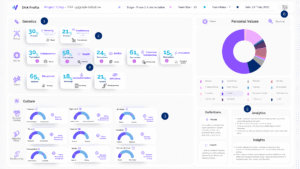
The structured results provide fantastic means for discussing what’s important and unique for Delivery Team Members.
For us, it is fascinating to see that what works for one Delivery Team in a unique environment is seen as a gap or a shortfall in another. The discussion is far more effective than debating the validity of a label that is attempting to outline of what you are, or what you might want to become.
So next time hear a culture catch cry in your business or are a part of a circular discussion attempting to label who you are or who you want to be, turn attention towards what the word culture means, and how you’re going about getting things done.
Label it later