
I was having coffee recently with a friend who ran operations at quite a large healthcare provider. One of his many accountabilities was to chair the organisation’s Transformation Portfolio Governance forum.
The ongoing portfolio had several projects at different stages of the delivery lifecycle, an aggregated set of continuous improvement accelerator’s and three major programs. The work included core technology upgrades, value proposition improvements and risk buy down / remediation activity. The estimated annual investment was around $50m with a forecast to spend similar in the following financial year.
I enquired about the portfolio’s performance. There was a slight agitation in the response.
All performance indicators showed that the portfolio was in reasonable shape. There were a couple of projects graded Amber due to known resourcing constraints and there was a vendor problem causing major issues on a core platform upgrade. Otherwise, the risk profile looked stable, as did the funding position for the next year. Still, my friend was uneasy:
“To be honest, I never really know how we are performing. Even though there is reporting for days, outcomes never really shoot the lights out, delivery staff are never overly happy, and benefits are always difficult to track. On top of being safe, I’m never overly satisfied with much else.”
I enquired about independent project health checks and there was a board appointed assurance partner that conducted a deep dive on a major project or program each half. It was seen as painful by staff and generally focussed on projects with either major change requests or performance issues. They usually resulted in opportunities to improve planning, tollgate reviews and solution design / due diligence activity, albeit narrow in focus.
“We continually seem to get specifically safer, rather than generally better”
I reflected with him on an experience I was having with another colleague in finance. Their particular organisational view was that healthy projects get health checks.
See below a stylised snapshot of a recent health check they conducted on a small ERP upgrade. The initiative was tracking green. Its was on time, scope was well managed, and it was on budget. Their health check dashboard showed some fascinating insights though to help get better:
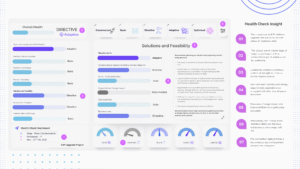
Their current delivery maturity was directive and they were striving to become more adaptive and even optimise certain delivery modules. A particular focus area was how well aligned their requirements gathering was to how process changes were identified, measured and controlled.
Whilst Business Analytics team members were technically strong at gathering, documenting and continually improving requirements, the business identified that if the exercise was better aligned process documentation, the quality, coverage and speed of requirements gathering could improve even further.
This insight was pushed to portfolio governance who helped apply the learning to another project that was in its early design phase. Delivery staff enjoyed the collaboration, business architecture was thrilled by more proactive engagement, and the portfolio got incrementally better.
So next time you’re sitting in a governance forum, challenge yourself. Are we there to just solve problems and ensure safety or are we there to strive to get continually better also?
If getting better is on your agenda, you’ll start insisting that healthy projects get health checks.